
WELCOME BONUS 300%
UP TO €2000 + 100
FREE SPINS
UP TO €2000 + 100
FREE SPINS
Home → Blackjack
Blackjack at Casino-Nine: Variants, Rules and Payouts
What Push Means: Stake Returns to You
In Blackjack, a 'push' occurs when the player's hand total equals the dealer's hand total, excluding a player blackjack. When this happens, the player's original stake is returned, meaning no win or loss is registered on that specific bet. This outcome is common and prevents a loss of the initial wager, acting as a neutral result in the game's progression.
For instance, if both the player and dealer achieve a hand total of 17, the result is a push, and the player receives their bet back. Unlike a loss where the stake is forfeited, a push signifies an even outcome where the bet remains unchanged. This distinguishes it from a win, where the payout is 1:1 or 3:2.
Understanding pushes is vital for beginners as it clarifies that not every hand results in a win or a loss. While a push returns the stake, it's crucial to remember that side bets, like Insurance which pays 2:1, are evaluated independently and can still result in a win or loss regardless of the main hand's push outcome.
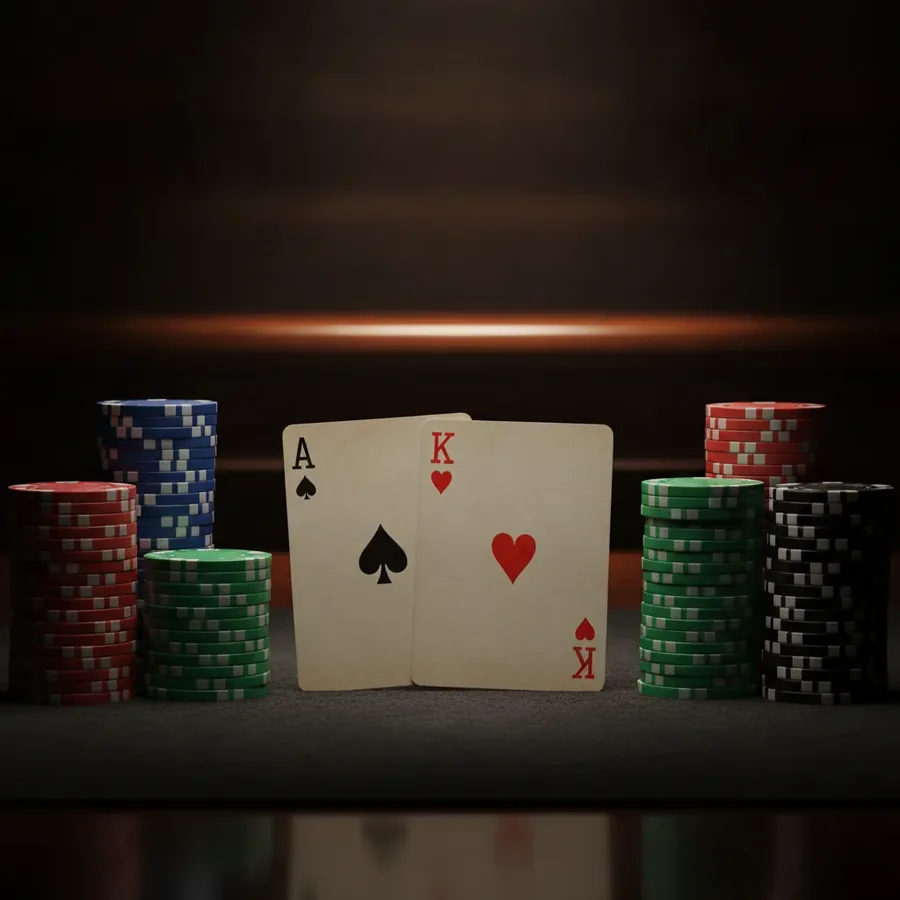
Why Loss Progression Quickly Reaches Table Limit
Blackjack's inherent volatility, especially with a low house edge of 0.15% for 'Blackjack Ein Deck', can lead to rapid fluctuations in a player's bankroll. While the house advantage is minimal, a series of unfavorable outcomes can quickly deplete a player's funds, particularly if larger stakes are employed. The RTP of 99.85% indicates long-term theoretical return, not session-by-session guarantee.
Consider the impact of a few consecutive losses, even with optimal play. If a player uses a progression system or simply increases their stake after losses, reaching the table limit becomes a significant risk. For example, a player betting €10 and experiencing three straight losses would be down €30, and doubling stakes could quickly escalate this. Table limits, such as the €5,000 maximum bet on 'Quantum Blackjack Plus Live', are in place to protect the casino but also cap potential recovery for players.
The consequence of rapid loss progression is the premature end of a gaming session. For beginners, it's essential to set strict budget limits and adhere to them, regardless of the game's perceived fairness or low house edge. For instance, a player aiming for a €2,000 welcome bonus with a 300% match would need to wager €6,000 before withdrawal, and rapid losses could make achieving this impossible.
Six Card Charlie Pays Immediately with Six Cards
The 'Six Card Charlie' rule, a less common but advantageous variation in some Blackjack games, offers a win if a player accumulates six cards without exceeding a total of 21. This rule essentially provides an alternative path to victory beyond achieving a superior hand total to the dealer. It is a specific rule modification that deviates from standard Blackjack play.
In scenarios where a Six Card Charlie is in effect, a player holding six cards that sum to 21 or less, even if their total is lower than the dealer's, is declared an immediate winner. This rule can significantly shift the odds in the player's favor, as it presents an additional winning condition. For example, if a player has 5, 4, 3, 2, 1, 5 (total 20) and the dealer has 21, the player still wins due to the Six Card Charlie.
For beginners, understanding such special rules is crucial for maximizing potential winnings. While standard blackjack strategy focuses on hitting, standing, doubling, and splitting, the Six Card Charlie rule adds a unique element. It's important to note that this rule is not universally applied across all Blackjack variants offered, and players should confirm its presence before playing.
Ignored Basic Strategy Chart: 1 Percent Wasted
Failing to utilize a basic strategy chart in Blackjack can lead to a significant increase in the house edge, effectively wasting potential returns. For a game with a theoretical RTP of 99.85% and a house advantage of 0.15% when playing 'Blackjack Ein Deck', deviating from basic strategy can easily add 1% or more to the casino's advantage. This means a larger portion of each wager is retained by the house over time.
For example, a common deviation from basic strategy involves hitting on a hand of 16 against a dealer's 10, when standing is mathematically the correct play. Such suboptimal decisions, when compounded, lead to the loss of valuable RTP. The 'Blackjack 6 Decks, S17, DAS, DOA, Auszahlung 3:2, Basisstrategie' variation, with a house edge of 0.46%, highlights the importance of following strategy, as adherence maximizes the 99.54% RTP.
The consequence for a beginner is a demonstrably worse player experience and reduced chances of long-term success. If a player ignores basic strategy, they are essentially playing with a house edge closer to 1.85% (as seen in 'Blackjack Auszahlung 6:5 statt 3:2') rather than the optimal 0.15% to 0.46%. This translates to a significant amount of money lost over many hands, especially when considering wagering requirements for bonuses, such as the 40x wagering on the €2,000 welcome bonus.
Even Money only possible with Dealer Ace
The 'Even Money' option in Blackjack is a specific side bet offered to players when the dealer's upcard is an Ace. This bet acts as a form of insurance against the dealer achieving a Blackjack, offering a 1:1 payout on the player's original bet if the dealer indeed has a Blackjack. It's important to distinguish this from the general 'Insurance' side bet.
When the dealer reveals an Ace, players are presented with the option to take Even Money. If the player accepts, and the dealer subsequently reveals a ten-value card to form a Blackjack, the player's bet is paid out at 1:1, effectively cancelling out the potential loss of their main bet. For instance, on a €10 bet, accepting Even Money and the dealer getting Blackjack results in a €10 win, preserving the original stake.
Crucially, the Even Money option is only available when the dealer's visible card is an Ace, as this is the only card that can complete a dealer Blackjack with their hidden card. If the dealer's upcard is not an Ace, the Even Money option is not presented, and the game proceeds under standard rules. This rule is distinct from the standard 'Blackjack Insurance' bet, which has a high house edge of 7.47% and is generally advised against by basic strategy.
Blackjack variants at a glance
| Variant | Payout | House edge | Rule | Bet range |
|---|---|---|---|---|
| Blackjack Auszahlung 6:5 statt 3:2 (6 Decks) | 98.15% | 1.85% | Ersatz von 3:2 durch 6:5 fügt exakt +1.39 Prozentpunkte zum Vorteil des Casinos hinzu – stärker als jede andere Regeländerung. Bei $10 Einsatz zahlt Blackjack $12 statt $15. | Blackjack 6:5, Gewinn 1:1 |
| Blackjack Split / Double / H17 – Regel-Effekte | n.a. (Regel-Modifikatoren) | H17 +0.22 Prozentpunkte; RSA −0.08 Prozentpunkte; DAS −0.14 Prozentpunkte | Dealer Hits Soft 17 verschlechtert RTP um 0.22 Prozentpunkte; Resplit Aces verbessert um 0.08 Prozentpunkte; Double After Split verbessert um ca. 0.14 Prozentpunkte; 6 Decks statt 8 – ca. 0.02 Prozentpunkte. | Double – Einsatz ×2 mit einer Karte; Split – bis 4 Hände; Ass-Split meist mit einer Karte. |
| Blackjack Ein Deck, klassische Regeln, 3:2 | 99.85% | 0.15% | Weniger Decks = niedrigerer Vorteil; ein Deck gibt ca. −0.48 Prozentpunkte gegenüber 8 Decks. Oft durch 6:5 Auszahlung kompensiert. | Blackjack 3:2, Gewinn 1:1 |
| Blackjack 6 Decks, S17, DAS, DOA, Auszahlung 3:2, Basisstrategie | 99.54% | 0.46% | Dealer steht auf Soft 17; Verdopplung auf jeder Zweierkarte; Verdopplung nach Split erlaubt; keine Aufgabe. Basisstrategie ist für diesen Wert zwingend | Blackjack 3:2, normaler Gewinn 1:1, Insurance 2:1 |
| Blackjack Surrender (Late Surrender) – Regel-Effekt | n.a. (Regel-Modifikator) | −0.08 Prozentpunkte | Spieler gibt Hand nach Dealer-Blackjack-Prüfung auf, verliert die Hälfte des Einsatzes. Verbessert RTP um ca. 0.08 Prozentpunkte. Early Surrender ist wesentlich wertvoller (bis −0.6 Prozentpunkte), aber extrem selten. | Rückzahlung 50% des Einsatzes |
| Blackjack Insurance / Versicherung (6–8 Decks) | 92.53% | 7.47% | Separate Nebenwette bis 50% der Hauptwette, wenn der Dealer ein Ass hat. Basisstrategie schreibt IMMER Ablehnung vor (außer Karten zählen bei True Count ≥ +3). Bei einem Deck Vorteil ≈ 5.88% | Insurance 2:1 |
Bust at 22: Stake Lost Immediately
In standard blackjack rules, a player who busts by exceeding 21 loses their stake immediately. This applies even if the dealer subsequently busts. In Casino-Nine's Blackjack 6 Decks variant, the house edge is a low 0.46% due to favorable rules like Standing on Soft 17 and Double After Split. This means players can expect a theoretical return of 99.54% over the long term.
The concept of busting is fundamental to blackjack strategy. For beginners, understanding when to hit and when to stand is crucial to avoid this immediate loss. Blackjack Insurance, a side bet where the dealer has an Ace, offers a payout of 2:1 but significantly increases the house edge to 7.47% if played without card counting.
By adhering to basic strategy, players can minimize the chances of busting and maximize their potential returns. For instance, the Blackjack 6 Decks variant, with its 0.46% house advantage, is designed to offer a more favorable player outcome compared to games with less optimal rules. This makes it an attractive option for those new to the game.
Surrender vs Playing Out on 16 vs 10
The Surrender option in blackjack allows a player to forfeit half their bet after the dealer checks for blackjack. This rule can reduce the house edge by approximately 0.08 percentage points, as seen in variants that offer Late Surrender. This is a strategic decision rather than a mandatory action, giving players control over a potentially losing hand.
For a player holding a 16 against a dealer's 10, playing out the hand carries a higher risk than surrendering. This rule is particularly valuable when facing strong dealer upcards.
Blackjack Surrender, specifically Late Surrender, offers a way to mitigate losses. When a player has a 16 against a dealer's 10, surrendering means losing only 50% of the stake instead of the full amount if the dealer achieves a better hand. This strategic retreat can preserve capital for future rounds.
Continuous Shuffling Machine shuffles after each round
A Continuous Shuffling Machine (CSM) is used in some blackjack games, notably at Casino-Nine's live tables, to shuffle cards after every hand. This differs from traditional shoe games where the shoe is reshuffled after a certain number of rounds. The CSM aims to provide a consistent and uninterrupted flow of play for players.
While CSMs can enhance the speed of play, they can also influence strategy. For games like Blackjack Insurance, where card counting can offer an advantage, a CSM makes this strategy much less effective. The RTP for Blackjack 6 Decks, S17, DAS, DOA with a 3:2 payout remains a strong 99.54%.
The use of a CSM ensures that each hand is dealt from a freshly shuffled deck, theoretically removing any influence from previous hands. This setup is common in live dealer environments to maintain game integrity and speed, ensuring that players engaging with games like Infinite Blackjack can expect rapid gameplay.
Latency under 2 seconds at the live table
For players at Casino-Nine's live tables, a key feature is the low latency, typically under 2 seconds. This ensures a responsive gaming experience, crucial for fast-paced games like Quantum Blackjack Plus Live, which accepts stakes from 1 to 5,000 EUR. Such low latency minimizes delays between actions and game responses.
This rapid response time is vital for games featuring multipliers, such as Lightning Blackjack with its up to 25x multipliers on winning hands. The efficient transmission of game data ensures that players can place their bets and react to game events without significant lag, contributing to a smoother overall experience.
A stable and fast connection is paramount for live dealer games. With latency under 2 seconds, players can confidently engage with various live blackjack offerings, including Infinite Blackjack, without the frustration of delays. This technical performance is a critical factor for maintaining an immersive and enjoyable live casino environment.
Infinite Blackjack uses the Six Card Charlie
Infinite Blackjack, available at Casino-Nine, incorporates the 'Six Card Charlie' rule. This means a player who achieves a hand totaling six cards without busting automatically wins, regardless of the dealer's hand. This rule adds an interesting dynamic to the game, offering an alternative path to victory beyond reaching 21.
The RTP for Infinite Blackjack is listed at 99.47%, indicating a favorable game for players. The Six Card Charlie rule, while not directly impacting the RTP calculation in the same way as payout ratios, provides an additional layer of strategy and potential winning opportunities that are not present in all blackjack variants.
For beginners, understanding the Six Card Charlie rule in Infinite Blackjack offers a clear advantage. If a player accumulates six cards without exceeding 21, they secure a win. This rule is active alongside other features like four side bets: Any Pair, 21+3, Hot 3, and Bust It.
Which hands are excluded from Surrender?
Late Surrender is a rule modification in Blackjack that allows a player to forfeit half their bet after the dealer checks for blackjack. This rule is specifically excluded from play when the dealer's upcard is an Ace, preventing its use in certain high-risk situations. The RTP for Blackjack with Late Surrender is improved by approximately 0.08 percent points.
While Late Surrender is a valuable option, its exclusion with a dealer Ace means players cannot mitigate losses in that specific scenario. The standard payout for a Blackjack remains 3:2, but the option to surrender is removed when the dealer shows an Ace. Early Surrender, which is far rarer, offers a more significant RTP improvement of up to 0.6 percent points.
For beginners, understanding when Surrender is available is crucial for managing bets. The Late Surrender option, when available, offers a 50% return of the stake. However, it is important to note that this option is not universally applicable across all dealer upcards, particularly when the dealer possesses an Ace.
Mobile version needs 1 Mbit bandwidth
Playing live dealer games like Quantum Blackjack Plus Live requires a stable internet connection to ensure a smooth experience. A minimum bandwidth of 1 Mbit is recommended for the mobile version of the casino. This ensures that the video stream from Playtech remains uninterrupted during gameplay.
This bandwidth requirement is particularly important for live casino games where the action unfolds in real-time. Games like Infinite Blackjack, which offers unlimited player positions, or Lightning Blackjack with its multipliers up to 25x, demand a consistent data flow. Insufficient bandwidth can lead to delays or disconnections.
For players using mobile devices, ensuring a Wi-Fi connection that meets or exceeds the 1 Mbit requirement is advisable. This will allow for uninterrupted play across all available live tables, including those with side bets such as Any Pair or 21+3.
16 vs 10 played incorrectly: most common error
A frequent mistake for novice players involves how they play a hand totaling 16 against a dealer's upcard of 10. The correct basic strategy dictates that a player should hit on a hard 16 when the dealer shows a 10. This strategic decision aims to improve the player's hand against a strong dealer upcard.
Failing to adhere to basic strategy, such as hitting a 16 against a 10, can significantly increase the house edge. For instance, Blackjack Liberal Vegas Strip, with liberal rules and a 3:2 payout, has a house advantage of only 0.28%. Deviating from optimal play increases this margin.
Understanding and applying basic strategy is paramount for new players to minimize the house advantage. For example, playing Blackjack 6 Decks with S17, DAS, and a 3:2 payout, under basic strategy, results in a house advantage of 0.46%. Incorrectly playing a 16 against a 10 widens this gap.
One Deck vs Eight Decks in House Edge
The number of decks used in a Blackjack game directly influences the house edge. A game utilizing a single deck, such as Blackjack Ein Deck with classic rules and a 3:2 payout, offers a superior RTP of 99.85%, translating to a house advantage of just 0.15%.
In contrast, games employing multiple decks, like the standard 6-deck variations, typically present a slightly higher house edge. For example, Blackjack 6 Decks with S17 and DAS has a house advantage of 0.46%. This difference means that fewer decks generally lead to a lower casino advantage, approximately 0.48 percent points less than an 8-deck game.
It is important to note that while fewer decks are statistically more favorable, some casinos may compensate by altering payouts. For instance, a Blackjack Auszahlung 6:5 instead of 3:2 in a 6-deck game increases the house advantage by a substantial 1.39 percent points, making it less appealing despite the deck count.
Card Counting at Shuffle Master Table: why it fails
Card counting, a technique used to gain an advantage in Blackjack, is rendered ineffective at Shuffle Master tables. These tables utilize continuous shuffling machines (CSMs), which constantly re-shuffle the decks after each hand. This constant shuffling prevents the accumulation of cards needed to alter the odds.
The core principle of card counting relies on tracking the ratio of high to low cards remaining in the shoe. When favorable for the player, it allows for strategic adjustments to betting and playing decisions. However, a Shuffle Master table's CSM negates this by ensuring a random distribution of cards at all times.
Therefore, attempting card counting at a Shuffle Master table, even with optimal strategy on games like Blackjack Liberal Vegas Strip (RTP 99.72%), will not yield the expected results. The inherent design of the continuous shuffling mechanism ensures the house edge, in this case 0.28%, remains consistent regardless of card tracking.
Contact
Live - online chat
Banking









Providers












Ninecasino 2026